Prologue: When Silicon Valley’s “Cold War” Turns into a “Hot War”
Over the past two years, the AI industry seems to have experienced a typical “disruptor story”: the agile startup OpenAI, relying on ChatGPT and Nvidia’s powerful computing power, caught the former tech giant Google off guard. The market narrative at the time was simple and crude—Google was too slow and had too much baggage, and seemed destined to become the next Yahoo or Kodak in this new era of generative AI.
However, with the sudden emergence of Gemini 3, the wind direction reversed dramatically overnight.
This is not just an upgrade of model parameters, but a dimensionality reduction strike on the business model of the AI industry. When developers discovered that Gemini 3 surpassed GPT-4o/o1 in performance while suppressing the price to a fraction of its competitors, and even showed overwhelming advantages in long text processing, the market finally realized: this war has never been purely a battle of “model algorithms”.
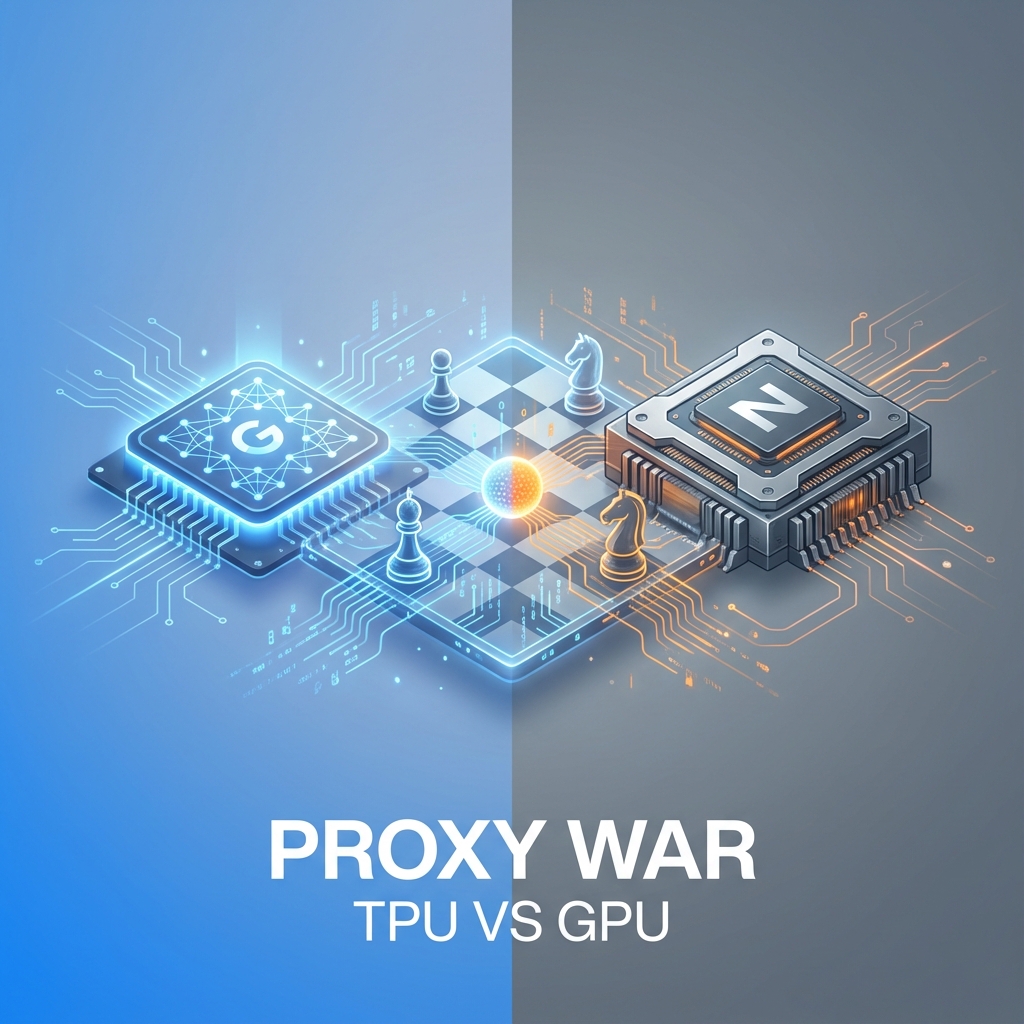
This is a “Proxy War”.
On the surface, it is a product battle between Gemini and ChatGPT; underneath, it is a showdown for computing hegemony between Google’s TPU vertical integration system and Nvidia’s GPU alliance system. OpenAI, in this game, actually plays the role of the top proxy for Nvidia’s computing power advantage.
This article will deeply analyze this endgame battle in three parts. In the first part, we will peel back the skin of technology and look directly at the cruelest essence of this war—the shift in cost structure and moats.
Chapter 1: Prologue — When the “Moat” is Filled
From 2023 to early 2024, OpenAI’s moat seemed indestructible. This moat was formed by the “scarcity of intelligence”: only OpenAI could provide the smartest models, so it had absolute pricing power. But the appearance of Gemini 3 declared the official drying up of this moat.
1.1 Gemini 3: The “Price-Performance” Massacre
If Gemini 2.5 Pro proved that Google could “catch up” with OpenAI, then Gemini 3 proved that Google could “crush” the cost structure.
After the release of Gemini 3, what shocked the developer community most was not its slight lead in benchmarks like MMLU (Massive Multitask Language Understanding), but the extreme optimization of its Inference Cost and Latency. Google successfully drove the price of high-performance models down to the “cabbage price” range.
This brought two direct consequences:
Commoditization of Intelligence: When the API price of top models approaches zero, relying solely on “being a little smarter” can no longer support high premiums.
Ecosystem Magnetic Effect: For startups and enterprises, when Gemini 3 can provide faster speeds at a lower cost (especially with ultra-long Context Windows), migration costs are no longer an issue, and the default status of OpenAI’s API begins to loosen.
1.2 Reversal of Public Opinion: From “Google is Too Slow” to “OpenAI is Too Expensive”
Just a few months ago, the market was still mocking Google’s organizational bureaucracy and product release delays. But now, the focus has shifted to OpenAI’s financial health.
OpenAI is in an awkward position: to maintain the status of the “strongest model”, it must train models with larger parameters and higher computing power consumption (such as the reasoning chain of thought of the o1 series), which leads to an exponential increase in its operating costs. However, Google utilized its deep engineering heritage to take a path of “efficiency optimization”—using less computing power to achieve the same level of intelligence.
The shift in market sentiment reveals a cruel fact: in the software industry, first-mover advantage is important; but in the cloud infrastructure industry, economies of scale and marginal costs are king.
Chapter 2: The Essence of the Proxy War — Google’s Vertical Integration vs. Nvidia’s Alliance Ecosystem
To understand why OpenAI appears so passive in the price war, we cannot just look at software; we must look at the supply chain logic behind these two camps. This is a war between the Google system and the Nvidia system.
2.1 Google’s Ultimate Weapon: No “Middleman Earning the Difference”
Google is currently one of the few (perhaps the only) tech giants on Earth with complete AI vertical integration capabilities. Let’s look at Google’s AI Stack:
- Chip Layer: Self-developed TPU (Tensor Processing Unit) v5e / v6 Trillium.
- Data Center Interconnect: Self-developed Jupiter optical fiber switching network and Apollo wide area network.
- Infrastructure Layer: Google Cloud Platform (GCP).
- Framework Layer: JAX / TensorFlow.
- Model Layer: Gemini.
- Application Layer: Google Search, Workspace, Android.
In this chain, Google does not need to pay hardware profits to anyone. The cost for Google to produce TPUs is the internal cost of goods sold (COGS); it does not need to let a second party other than TSMC (like Nvidia) earn a gross margin of 70% or even higher.
This is the confidence behind Gemini 3’s price war. When Google sells you 1 million tokens of computing power, this is just its internal electricity and hardware depreciation cost; but when OpenAI sells you the same computing power, it must first pay Microsoft Azure’s bill, and Microsoft Azure must pay for Nvidia’s expensive chips.
2.2 OpenAI’s Structural Dilemma: The Heavy “Nvidia Tax”
OpenAI is the brightest star in the Nvidia GPU ecosystem, and also the most typical “tenant farmer”.
OpenAI’s computing power foundation is built on Nvidia’s GPUs. Although GPUs are versatile and have a rich ecosystem (CUDA), Nvidia, as the “arms dealer” of the AI era, has extremely high pricing power. This results in a large portion of every penny of OpenAI’s revenue essentially being handed over to Nvidia.
Layered Costs: OpenAI’s model training and inference costs = Chip manufacturing cost + Nvidia’s huge profit + Server manufacturer profit + Microsoft Azure’s cloud service profit.
Hardware Cannot be Optimized: OpenAI cannot, like Google, modify the underlying chip design logic for the Transformer architecture (although Microsoft is trying to develop its own Maia chip, the main force is still Nvidia GPUs).
Therefore, the essence of this war is: Google cooking with “home-grown vegetables” (TPU) vs. OpenAI cooking with “expensive imported ingredients” (Nvidia GPU). As long as Google’s cooking skills (model algorithms) catch up with OpenAI, OpenAI has almost no chance of winning in price competition.
2.3 Nvidia’s Dilemma and Calculation
In this proxy war, Nvidia’s role is very subtle.
OpenAI is Nvidia’s best billboard: The stronger OpenAI is, the more it proves that GPUs are irreplaceable, and the more stable Nvidia’s stock price is.
Google is Nvidia’s biggest potential threat: Google proves that “you don’t necessarily need GPUs to make top-tier AI”, which directly challenges Nvidia’s narrative logic.
Therefore, Nvidia must fully support OpenAI (as well as xAI, Meta, and other customers) to ensure that GPUs always represent the “highest performance” of AI. But this also creates the current polarization of the AI industry:
Google Camp: Pursuing the ultimate Performance per Dollar, trying to turn AI into an infrastructure as cheap as water and electricity.
Nvidia/OpenAI Camp: Pursuing the ultimate Peak Performance, constantly pushing up the ceiling of computing power, but also accompanied by amazing energy consumption and costs.
Summary: The Shift of the Battlefield
If the battlefield continues to stay on “pure text generation” or “API services”, OpenAI will be slowly strangled by Google’s low-cost advantage. Google is using the economies of scale of TPUs to fill OpenAI’s first-mover advantage.
So, is OpenAI doomed?
Absolutely not.
Just like all wars in history, when one front falls into a stalemate (or disadvantage), a smart commander will open up a “second front”. The alliance between OpenAI and Nvidia is quietly shifting its focus from the “cloud dialogue box” to areas that Google cannot reach—areas that require high-intensity simulation, real-time physical reaction, and edge computing capabilities.
This is the subject we will explore in the next article: From Digital Brain to Physical AI (PAI) — The Jedi Counterattack of OpenAI and Nvidia.
Next Preview
- PAI (Physical AI): Why is Embodied AI Nvidia’s real moat?
- Military and Aerospace: When AI needs to enter the battlefield, why does TPU’s “cloud attribute” become a disadvantage?
- OpenAI’s Transformation: From Chatbot to “The Brain of Everything”.