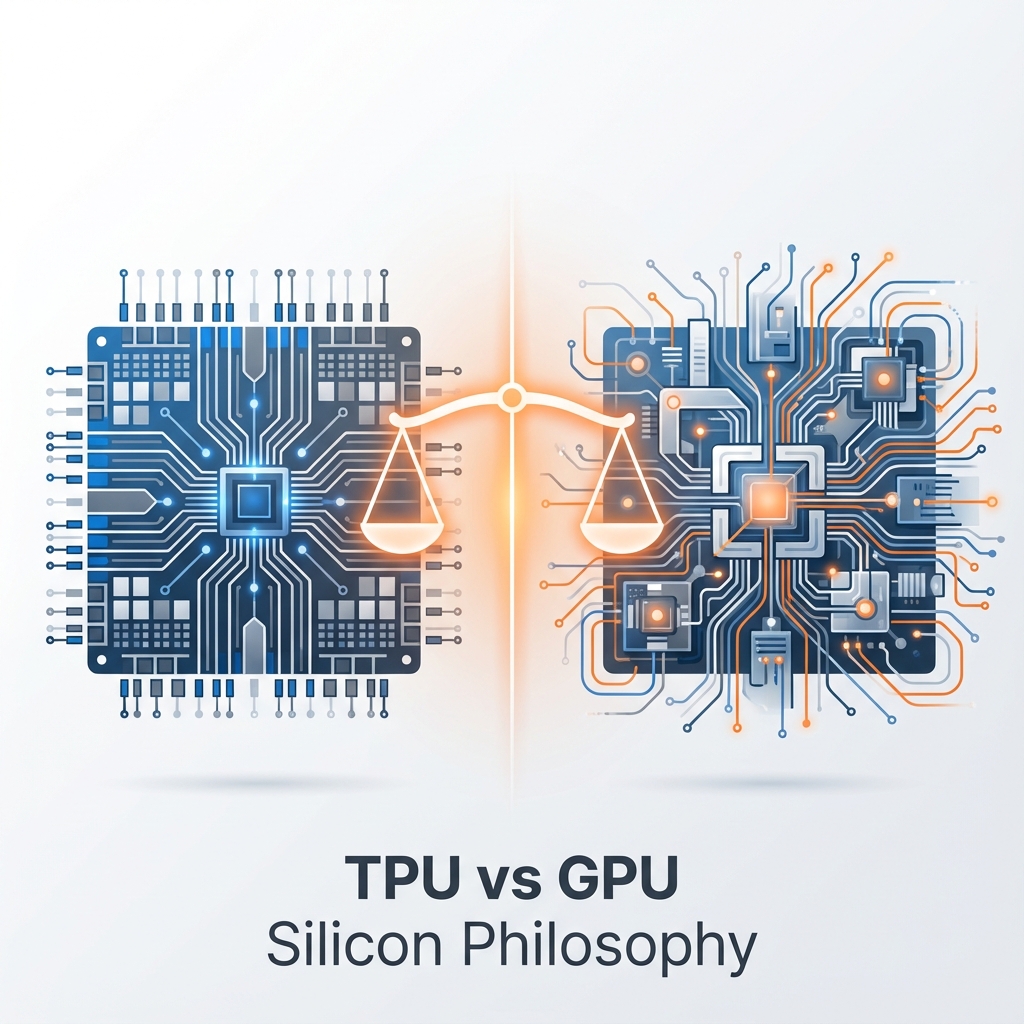
Prologue: Two Philosophies on Silicon Chips
In the previous two analyses, we moved from the “price war of business models” to the “new battlefield of Physical AI”. Now, we want to uncover the most underlying logic of this proxy war—this is not just a competition between Google and Nvidia, but a collision of two distinct computing philosophies in the computer science world.
The result of this collision will determine the profit distribution of the AI industry in the next decade, and who can hold the final key to Artificial General Intelligence (AGI).
Chapter 1: Special Forces vs. Mercenaries — The Duel between ASIC (TPU) and General Purpose Computing (GPU)
To understand why Google can achieve such amazing cost control on Gemini 3, we must return to the essential difference in hardware architecture.
1.1 TPU: “Special Forces” Born for Order
Google’s TPU (Tensor Processing Unit) belongs to ASIC (Application-Specific Integrated Circuit).
- Philosophy: Its design has only one purpose—to execute Matrix Multiplication extremely efficiently, which is the core of deep learning. It cuts out all functions irrelevant to AI, such as graphics rendering and ray tracing.
- Advantage: Because it is focused, it is efficient. When processing standard Transformer architecture models (such as Gemini), the unit energy consumption and heat dissipation efficiency of TPUs are far superior to GPUs. It’s like a racing car tailored for an F1 track; on a paved track (standard model inference), no one can beat it.
- Strategic Status: Google views TPU as “utility infrastructure”. Its goal is not to sell chips, but to make the operating costs of its own services (Search, YouTube, Gemini) approach zero.
1.2 GPU: “Universal Mercenaries” Embracing Chaos
Nvidia’s GPU (Graphics Processing Unit) is a General Purpose Parallel Computing Processor.
- Philosophy: It emphasizes flexibility. Through the CUDA software layer, GPUs can run AI training today, mine cryptocurrency tomorrow, and do weather simulation the day after tomorrow.
- Advantage: Flexible adaptation to the unknown. When AI researchers invent a brand new algorithm that existing ASICs (TPUs) may not support, GPUs can run it just by updating the driver. It’s like a rally car; whether it’s desert, mud, or snow (various unknown AI architectures), it can adapt.
- Strategic Status: Nvidia views GPUs as “shovels for gold diggers”. It doesn’t care what you dig up (text, images, or protein structures); as long as you are digging, you have to pay.
Chapter 2: Grey Rhino Risk — Is Transformer the End Point?
This is the biggest risk that all investors betting on the Google camp must consider: Architecture Lock-in.
2.1 Google’s Gamble: Long Live Transformer
Google’s TPU v5/v6 is highly optimized for the Transformer architecture. Google is betting that Transformer has become the x86 instruction set of the AI world, and AI in the next decade will be built on this architecture.
- Odds of Winning: At present, the dominance of Transformer is unrivaled. As long as this assumption holds, Google’s TPU can maintain its cost advantage.
2.2 Nvidia’s Moat: Guarding Against “Paradigm Shift”
However, academia has been looking for alternatives to Transformer (such as SSMs, Mamba architecture, Liquid Neural Networks, etc.) to solve the defect that Transformer’s calculation amount grows with the square of the length.
- Risk: If a revolutionary new architecture appears tomorrow that no longer relies on matrix multiplication but on other computing logic, Google’s TPUs may become expensive scrap metal (or greatly reduced in efficiency) overnight.
- Nvidia’s Antifragility: For Nvidia, this is actually a positive. New architectures usually mean that stronger general computing power is needed to explore, which is exactly where the CUDA ecosystem is strongest. Nvidia is a friend of “chaos”, while Google needs “order”.
Chapter 3: Endgame Prediction — The Establishment of a Bipolar World
Based on the above analysis, we predict that the future AI industry will split into two distinct camps:
3.1 Google Camp: Utility of AI
- Role: Playing the role of the “Water Plant” of the AI world.
- Characteristics: Providing standardized, extremely low-cost, extremely low-latency foundation model services.
- Dominant Areas: Search engines, word processing, real-time translation, consumer assistants.
- Winner Logic: Economies of scale. Whoever can suppress the Token price to the lowest wins.
3.2 Nvidia (OpenAI) Camp: Frontier Exploration of AI
- Role: Playing the role of the “Laboratory” and “Heavy Industrial Base” of the AI world.
- Characteristics: Providing the most powerful but expensive computing power to solve the most difficult problems.
- Dominant Areas: Scientific research, drug development, Embodied AI (robotics), complex reasoning, and all “non-standardized” innovative applications.
- Winner Logic: Technology premium. Whoever can solve problems that others cannot solve wins.
Chapter 4: Action Guide — Advice for Investors and Entrepreneurs
In this proxy war, as bystanders, how should we position ourselves?
4.1 Advice for Investors (Hedge Strategy)
- Hedge Strategy:
- Hold Google: If you are optimistic about the large-scale popularization of AI applications (such as everyone using AI to write emails). Google has the strongest vertical integration and can eat the profit margin repair dividend after AI popularization.
- Hold Nvidia: If you are optimistic about the continuous iteration and “physicalization” of AI technology (robots). Nvidia is the only company that can profit from “uncertainty”.
- Observation Indicators:
- Closely watch OpenAI’s gross margin. If it can get rid of the cost constraints of Microsoft/Nvidia through dedicated hardware (Jony Ive’s device), its valuation logic will be re-evaluated.
- Watch Google Cloud’s external revenue growth. See if TPU successfully transforms from “self-use” to “public cloud computing power” widely adopted by external enterprises.
4.2 Advice for Entrepreneurs
- Do not compete with Google on “Price”:
- If you are making a pure text generation Wrapper (shell application), Gemini 3’s low-price strategy will leave you with no way out.
- Strategy: Make good use of Google’s API to reduce your operating costs and use it as cheap water and electricity.
- Go to “Edge” and “Physical”:
- The shift of OpenAI and Nvidia points out the direction. Develop vertically integrated hardware or edge computing models for specific scenarios (factories, agriculture, health monitoring).
- This is an area where Google’s tentacles are hard to reach, and it is also a strategic high ground that giants are willing to acquire at a high price.
- Embrace “Compound AI Systems”:
- Future applications will not rely on a single model alone. The smart architecture is: use cheap Gemini for preliminary processing (Cost Saving), call expensive OpenAI o1 for reasoning when encountering difficult problems, and use Nvidia hardware locally for real-time feedback. Becoming an expert in this “hybrid architecture” will have huge market demand.
Epilogue: The War Has Just Begun
The release of Gemini 3 is not the end point, but the starting point of a new round of arms race in Silicon Valley. Google has proved the power of “vertical integration” in the software era; while Nvidia and OpenAI are proving the resilience of the “alliance ecosystem” in the hardware era.
For us, this is not a question of choosing sides, but seeing the wind direction clearly and finding our own opportunities on the shoulders of giants. Because whether TPU wins or GPU wins, the era of AI has irreversibly arrived.