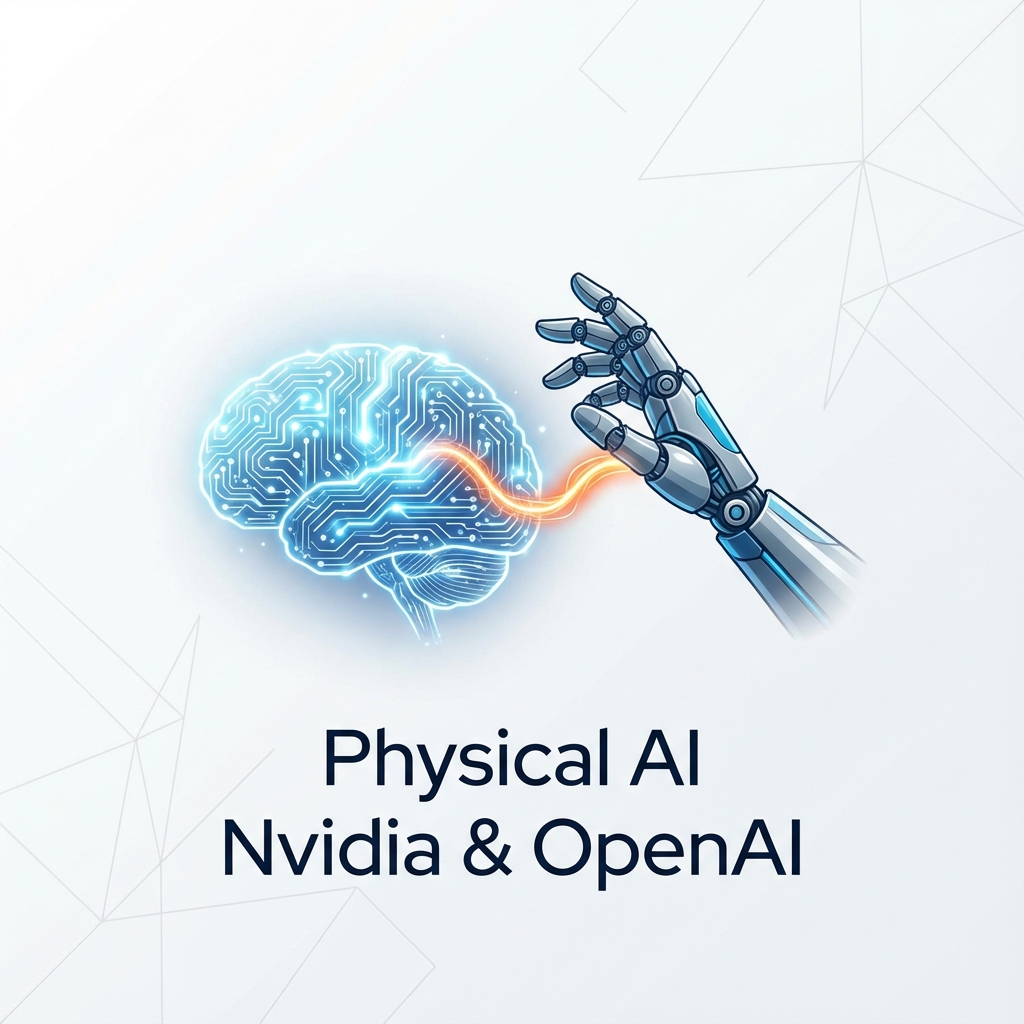
Prologue: Breaking Out of the “Brain in a Vat” Dilemma
In the previous article, we analyzed how Google used the vertical integration of TPUs and the cost advantage of Gemini 3 to besiege OpenAI on the “cloud pure software” battlefield. If the future of AI is merely generating text, images, or writing code, then OpenAI will be extremely passive in this price cutthroat war.
However, another revolution in Silicon Valley is quietly happening. Current LLMs (Large Language Models) are essentially “Brains in a Vat”. They are trapped in server rooms, talking to the world through APIs, but are always subject to the terminal high walls built by Google (Android) and Apple (iOS).
OpenAI realized that to break through, it must have its own “body” and “carrier”. This counterattack is divided into two steps: the first step is Consumer AI Devices, and the second step is the grander Physical AI (PAI).
Chapter 1: Hardware Breakout — Starting with Jony Ive’s Mysterious Device
Before talking about robots, we must first focus on OpenAI’s most important strategic shift in 2025: Retaking control of the hardware entrance.
1.1 Searching for the iPhone of the AI Era
As early as 2024, OpenAI was in frequent contact with former Apple legendary designer Jony Ive (LoveFrom). By 2025, this mysterious AI hardware project finally surfaced. This is not just a “hardware with ChatGPT”, but OpenAI’s ambition to define the “post-smartphone era”.
- Why do hardware?: As long as ChatGPT is just an App, it will always be a “tenant farmer” in the Apple and Google ecosystems, and may be choked at any time due to platform policies or commission issues. Gemini has Pixel phones and the Android system as native carriers, which is a channel advantage that OpenAI cannot match.
- Jony Ive’s Role: OpenAI leverages Jony Ive’s design aesthetics to try to create an interactive device that is more natural and invasive (Ambient Computing) than mobile phones. This device no longer relies on screen clicks, but emphasizes voice interaction, visual perception, and active intelligence.
1.2 Getting Rid of Single Dependence, Reconstructing Physical Layout
In the past, OpenAI bet heavily on Figure AI to try to enter the robotics field, but after the two parties split in early 2025, OpenAI’s strategy became clearer and more radical: Do not rely on a single startup, but define the standard yourself.
The AI Device led by Jony Ive is the first piece of the puzzle for this strategy—it is a Consumer PAI. It gives OpenAI’s model “eyes” and “ears” for the first time, enabling it to directly perceive the user’s physical environment instead of waiting for the user to input text. This marks OpenAI’s formal transformation from a “cloud service provider” to a “soft-hard integrated tech giant”, trying to open up a new path directly to users outside Google’s digital wall.
Chapter 2: Nvidia’s “Power Move” — Building the “Matrix” of the Physical World
If Jony Ive’s device is OpenAI’s tentacle for consumers, then the alliance with Nvidia is to conquer the broader industrial and robotics markets. Nvidia plays an indispensable role as an “arms dealer” in this proxy war.
2.1 Project GR00T and Jetson Thor: Defining the Brain of Robots
Nvidia’s Project GR00T released at the 2024 GTC conference is a foundation model platform designed specifically for humanoid robots. Combined with the Jetson Thor chip, Nvidia is trying to replicate its success in the PC era—becoming the Intel of the robotics era.
- Jetson Thor: This is an edge computing SoC designed specifically for robots, with computing power up to 800 TFLOPS. This means that robots do not need to send all images back to the cloud, but can make real-time decisions directly on the “local” brain.
- Strategic Significance: As long as robots need efficient computing locally, Nvidia’s hardware architecture is the first choice. Although Google currently has Edge TPU, it has not yet produced a killer product that can compete with Thor in the field of high-performance robot computing.
2.2 Isaac Lab and Omniverse: Monopoly of the Training Ground
Google has Waymo’s real road test data, which is its advantage. But Nvidia chose a more scalable path: Simulation.
Through the Omniverse platform and Isaac Lab, Nvidia created a virtual world that follows the laws of physics.
- Sim-to-Real: OpenAI’s models can undergo “fall and get up” training in Nvidia’s virtual world at 1000 times the speed, and then download to physical robots after learning to walk.
- Moat: Nvidia is becoming the “infrastructure” for all physical AI companies. Whether it is OpenAI’s self-developed device or other robotics companies, they all need this virtual training ground.
Chapter 3: New Battlefield — The “Offline War” of Military, Aerospace, and Drones
If consumer devices and robots still need time to popularize, then in the defense and high-tech industries, the combination of Nvidia + OpenAI has already shown strong combat effectiveness. This is also why there is a view on the Internet that OpenAI will not be doomed—because national security needs it.
3.1 OpenAI’s Clause Revision and Military Signals
In 2024, OpenAI quietly removed the explicit wording in its terms of use regarding “prohibition of military and warfare use”, which is an extremely important signal. Modern warfare has evolved into a war of drones and AI. In a battlefield environment with strong electromagnetic interference, relying on Google Cloud’s cloud AI is fatal because communication can be cut off at any time.
3.2 Absolute Advantage of Edge Inference
At this time, Nvidia’s edge hardware + OpenAI’s Distilled Model becomes a golden combination:
- Scenario: A loitering munition or reconnaissance drone needs to identify camouflaged targets and make attack decisions within milliseconds.
- Tech Stack: This requires carrying Nvidia Orin or Xavier modules (small size, low power consumption, strong computing power), running a lightweight model fine-tuned by OpenAI.
- Google’s Absence: Google’s TPUs are mainly “behemoths” designed for server rooms. In this battlefield that requires extreme edge performance, Nvidia’s ecosystem occupies absolute dominance.
3.3 Aerospace and Scientific Exploration
The same logic applies to aerospace. On a Mars rover, the signal round trip to Earth takes 20 minutes, and AI must have complete autonomy. This kind of “autonomous intelligence” in extreme environments is a high-value safe haven for OpenAI to escape Google’s price war quagmire.
Chapter 4: Conclusion — Misplaced Competition of Dual Oligarchs
At this point, we can clearly see that the competitive landscape of the Google and Nvidia (OpenAI) camps is undergoing essential differentiation:
-
Google (TPU + Gemini):
- Battlefield: Cloud, SaaS, Search, Mobile Assistant.
- Strategy: Use vertical integration advantages to turn AI into a Utility as cheap as water and electricity.
- Advantage: Cost control, long text processing, Android ecosystem integration.
-
Nvidia (GPU + Edge) & OpenAI:
- Battlefield: Dedicated AI devices, robots, military defense, high-end edge computing.
- Strategy: Through hardware innovation (Jony Ive) and edge computing power (Nvidia), build the brain and body of Embodied AI.
- Advantage: High-end computing performance, independence from mobile ecosystems, simulation environments.
Conclusion: OpenAI only faces the risk of being “doomed” when competing with Google in homogenized “chatbots”. Once it turns around and embraces consumers through Jony Ive’s device and moves towards the physical world combined with Nvidia’s PAI ecosystem, it will enter a blue ocean.
This is not a game of who destroys whom, but a divergence of Software as a Service (SaaS) and Hard Tech.
Next Preview
- The Ultimate Duel of Underlying Technology: TPU (ASIC) vs. GPU (General Purpose Computing).
- Architecture Risk: Is Transformer the end point? If the algorithm changes, whose hardware will become scrap metal?
- Inspiration for Investors: How to layout your investment portfolio based on these two routes?